

Custom Software vs. Off-the-Shelf Tools: When Should Small Businesses Build?
 Yahya Bandukwala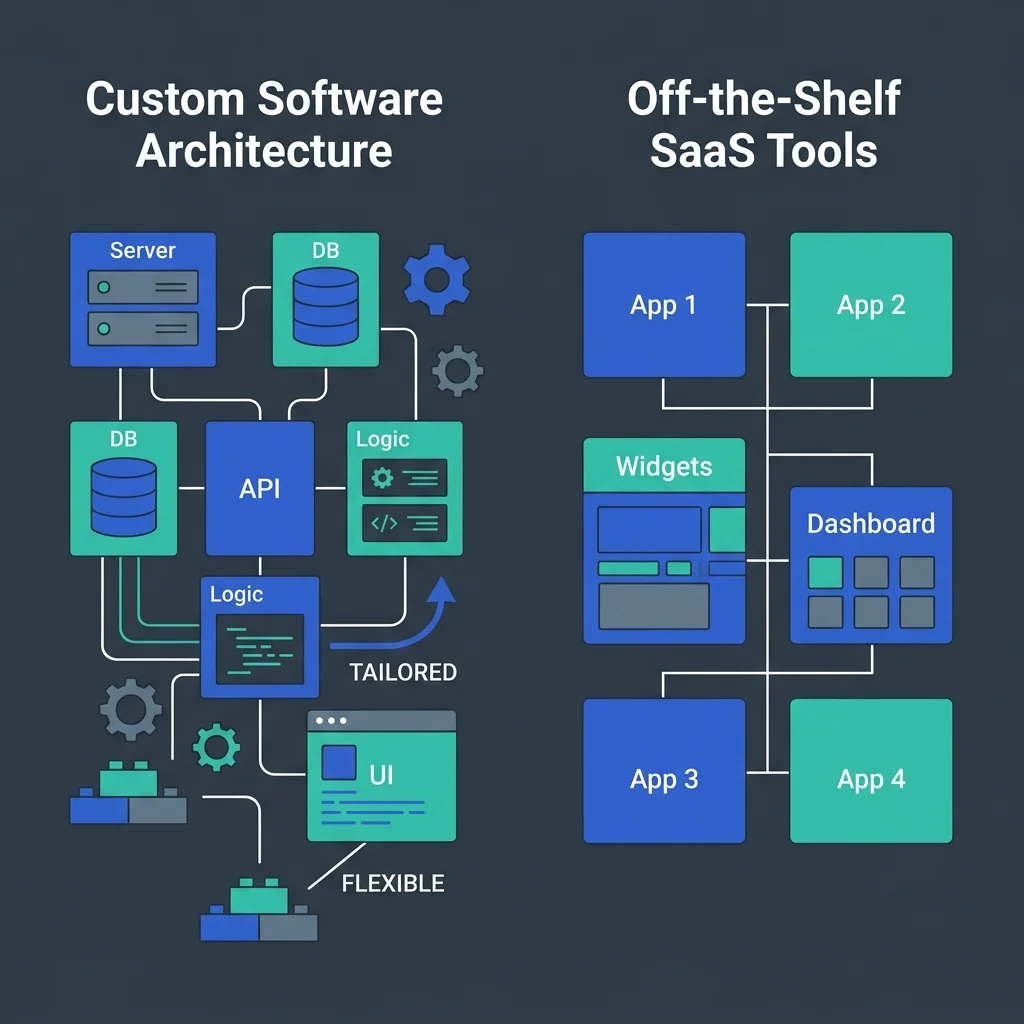
AI Summary
Instant Insights- Off-the-shelf SaaS fees escalate quickly while forcing your business into rigid, average workflows.
- Custom software automation eliminates 15+ hours/week of manual processing and yields 100% data ownership.
- Direct founder architecture with zero agency overhead ensures rapid ROI and clean long-term scalability.
When scaling a business, every founder eventually hits a wall with off-the-shelf software. What starts as a convenient $29/month SaaS subscription slowly turns into a patchwork of 10 disconnected tools, manual copy-pasting across spreadsheets, and monthly recurring licensing costs that scale faster than revenue.
As a principal software engineer and consultant at Raj Digital Solutions, I frequently advise business leaders on evaluating whether to stick with standard tools or invest in custom digital software. Here is a practical framework to help you decide.
1. The Hidden Costs of Generic SaaS
Off-the-shelf software is built for the average business. That means:
- Rigid Workflows: Your team has to adapt your operating procedures to fit the software, rather than the software fitting your process.
- Data Fragmentation: Your customer records live in CRM tool A, invoices in tool B, and operational logs in tool C.
- Subscription Creep: As team size grows, per-user licenses escalate dramatically without offering tailored features.
2. When Custom Software Makes Sense
Building custom digital solutions yields massive ROI under specific business conditions:
A. Core Competency & Competitive Advantage
If your internal workflow or service delivery model is your secret sauce, generic software dilutes your competitive edge. Custom internal portals, quote generators, or automated dispatch engines protect your proprietary IP.
B. High Volume Manual Processing
If your employees spend 15+ hours per week manually extracting data from PDFs, re-entering Excel data, or manually sending transactional emails, bespoke RPA (Robotic Process Automation) pays for itself within months.
C. Strict Compliance & Data Ownership
Owning your software stack means owning your database without vendor lock-in or fear of third-party price hikes.
3. My Architectural Approach
Unlike traditional development agencies that assign your project to junior developers and charge retainer markups, I provide direct founder accountability:
- Lightweight Architecture: Built without bloated frameworks, ensuring sub-100ms loading speeds.
- Direct Founder Engagement: 100% of code, database design, and cloud deployments are architected directly by me.
- No Subscription Lock-in: You own your code and deployment infrastructure.
Conclusion
Before signing up for another SaaS tier, evaluate the cost of employee time spent working around software limitations. When your workflow is custom, your software should be too.
Have questions about custom web development or workflow automation? Reach out on WhatsApp to discuss your technical architecture.